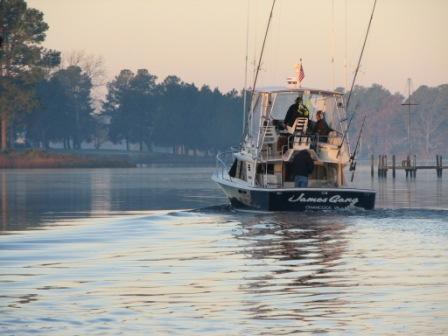
Onancock is one of the most beautiful and oldest towns on the lower eastern shore. The main street leads to a town dock where anglers can unload for a small daily fee or by purchasing a seasonal pass. The ramp has little incline and is not suitable for large float-on type trailers.
Onancock Creek winds roughly 10 miles out to the Chesapeake Bay. The creek is well marked but disregarding buoys is almost sure to result in grounding as the channel is narrow in some spots with shallow sandy bottom on either side.
Near the mouth of the creek are sandy beaches, ideal for sunbathing. Further along the estuary are marshy stretches with grass beds, points and other fish attracting structure.
Once in the bay, fisherman will find a series of hard bottoms along the channel edge. Among these are Robin Hood, Stone Rock, Crammy Hack, Hack’s Rock, Anglers Reef and others.
Not to be overlooked are some of the excellent shallow areas such as Watts and Parker Islands. Parker Island is on the southern side of the mouth of Onancock Creek. The area is very shallow, with beds of grass and areas of sandy and stumps. Red drum, trout, and rockfish frequent the area at times.
Across the channel is Watts Island. The island has a long history and is impressive to visit. Now nearing the end of it’s life, Watts Island was once much larger and even had a population of goats. The southern tip of the island housed a lighthouse. As erosion took it’s toll, the lighthouse was lost into the bay and all that is a left is a few piles of submerged rubble which act as a fish haven.
The rest of the island’s perimeter is a mix of sandy bottom, grass beds, and stumps. The island itself is now a very beautiful but desolate place, overrun with poison ivy and reptiles. Watts Island is also a rookery for hundreds of herons, egrets, gulls, and other aquatic birds.
Anglers fish the various hot spots from spring the early winter depending on species and fishing style. In the past Onancock was well known for outstanding catches of gray trout, black drum, and even cobia. While some of these fish have declined, anglers still catch a wide array of fish including croaker, spot, flounder, bluefish, Spanish mackerel, speckled trout, red drum, black drum, and others.
Onancock is often a good spot for late season fishing. In September croakers, trout and large Norfolk spot school up along the deeper structure and anglers seek out these fish for the table. As the water cools, striped bass known locally as “rockfish” are found first in the shallows and then schooled in the channels or other parts of the bay.
In November and December migrating rockfish merge as fish from the Chesapeake Bay move south while ocean run fish move up to intercept exiting baitfish. Fishermen watch the gannets and other birds and shadow the schools of menhaden which are a sure sign of trophy rock nearby. The fishing can become hot and heavy, and last thru mid-December before the fish finally move to the lower Chesapeake Bay.