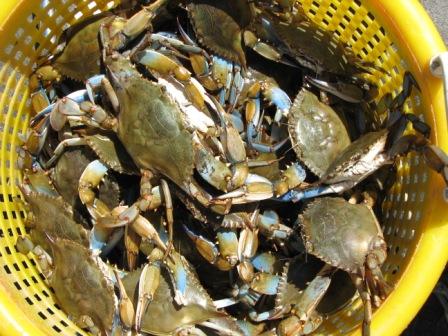
Trotlines can be highly effective for catching Atlantic blue crabs. Building a trotline is within the ability of the weekend boater, and there are no set rules to its design except for legal restrictions on length.
The basic recreational crabbing trotline is several hundred feet long, with anchors and buoys on either end. Baits are spaced at intervals along the line and the crabber maneuvers the boat along the line, netting crabs that hang on to the baits.
The main anchor holds the trotline in position while the other end is positioned down current and anchored by a lighter weight which allows the rig some movement. The system should hold the trotline in position, but allow it stay aligned with the flow of water.
A good starting point is 15 lbs for the main anchor and 5 lbs for the down current end. Anchors can be store bought boat anchors, window sash weights, or anything with enough weight. The crabs don’t seem to care so the material is a matter of preference.
A simple anchor-float system might utilize a large 3 way swivel, a buoy (jug) with adjustable line, 5-10 feet of line to the anchor and some provision to connect the trotline.
The line itself can vary in diameter or length. Many recreational crabbers use #5 (5/32″) nylon line although larger line works well too. Smaller lines are prone to tangling. One time saving trick is to cut small lengths of automotive fuel line or clear plastic hose, then slide a loop of line thru the hose. The bait is then placed in the loop and the line is pulled tight. This holds the bait on the line but eliminates knots and allows for fast bait changes.
Many baits are used and any bait that attracts crabs and is durable is fine. Trotliners often favor baits such as brined eels, bull lips, chicken parts, pork, or fish parts.
The entire line can be pre-baited and stored in a brine solution or dropped in a bait freezer, or rigged the night before and kept on ice. It is important to bring extra bait and replace baits as needed during the trip.
In the upper Chesapeake Bay, razor clams are a favorite bait. Razor clams are placed in a mesh bag, which is connected onto the line.
Fishing a trotline is fairly simple if the correct environment is available. A good trotline area will be shallow with a muddy bottom and moderate current. Some wind will actually help, and murky water allows crabbers to work longer. Most trotline crabbers prefer to get on the water early and finish before mid-day. Crabs are more active in the morning and less likely to spook when the trotline is moved.
Teamwork is important while crabbing with a trotline. One person steers the boat, while another retrieves the line and dips the crabs. If 3 people are present, the job gets easier as there is always a bait to change, crabs to cull or a buoy to recover.